Molar Mass vs. Molecular Weight vs. Formula Mass: What's the Difference?
Clear definitions of molar mass, molecular weight, formula mass and atomic mass units, why their numbers match, and how to calculate each from a chemical formula.
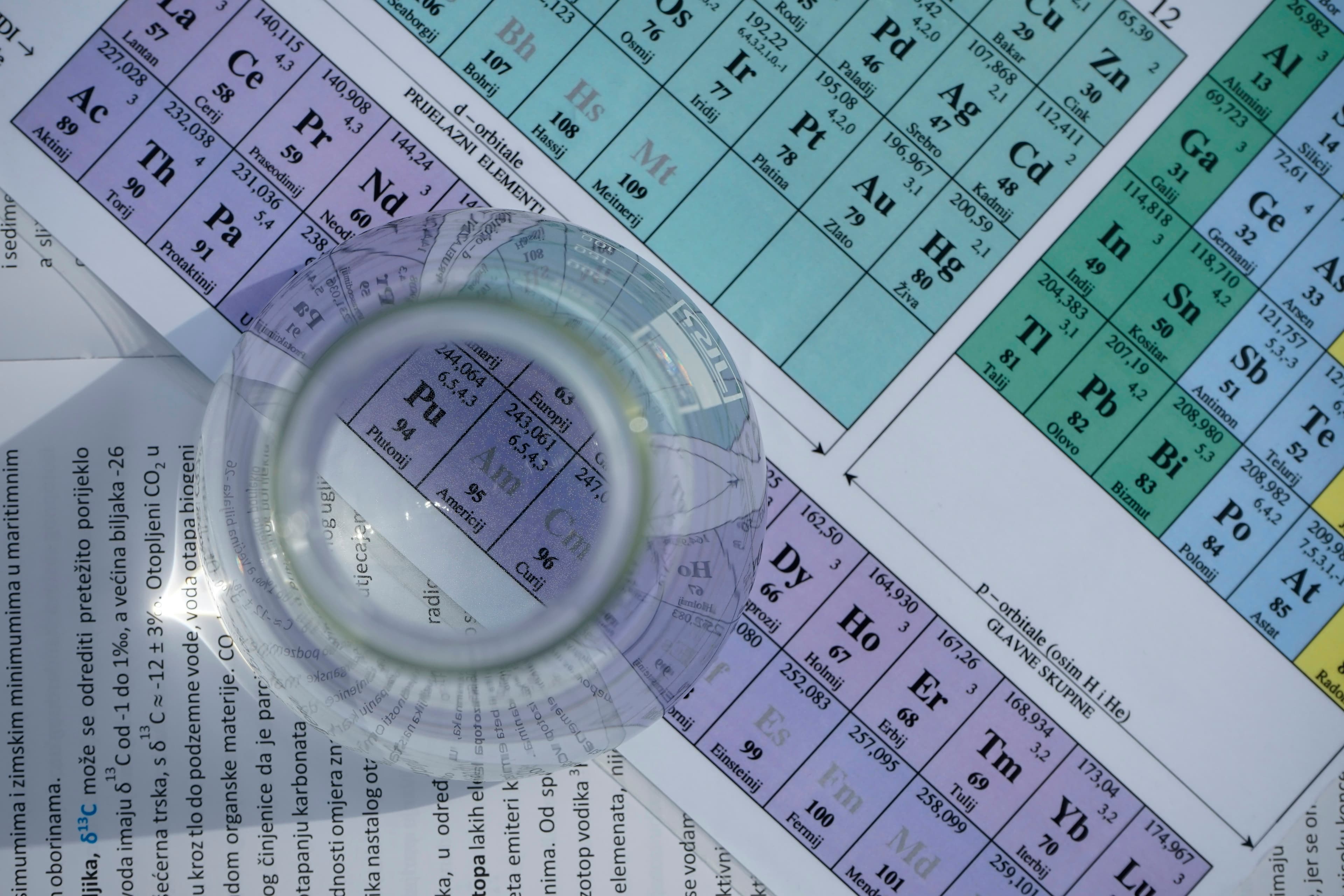
Chemistry textbooks use several terms that seem to mean the same thing: molar mass, molecular weight, molecular mass and formula mass. For everyday calculations they give the same number, but they aren't quite the same idea, and knowing the difference helps you use units correctly.
The definitions
| Term | Meaning | Units | Water |
|---|---|---|---|
| Molecular mass | Mass of one molecule | daltons (Da) or atomic mass units (u) | 18.015 u |
| Molecular weight (relative molecular mass) | Mass of a molecule relative to 1/12 of a carbon-12 atom | none (dimensionless) | 18.015 |
| Formula mass | Same idea for ionic compounds, which don't form discrete molecules | u | — |
| Molar mass | Mass of one mole of a substance | g/mol | 18.015 g/mol |
Why the numbers match
The mole was defined so that the mass of one mole, in grams, equals the mass of one particle in atomic mass units. A mole is exactly 6.02214076 × 10²³ particles (the Avogadro number). So one water molecule has a mass of about 18.015 u, and a mole of water molecules has a mass of about 18.015 g. Since the SI redefinition of 2019, this match is extremely close rather than exact by definition, but the difference is far too small to matter outside precision metrology.
Calculating any of them
Add the atomic weights of every atom in the formula:
H₂SO₄ = 2(1.008) + 32.06 + 4(15.999) = 98.072
That's 98.07 u per molecule, a relative molecular mass of 98.07, or 98.07 g/mol. The molecular weight calculator does the addition for any formula and shows each element's share.
Ionic compounds and formula mass
Sodium chloride exists as a lattice of Na⁺ and Cl⁻ ions, not as separate NaCl molecules. Chemists therefore talk about its formula mass (58.44 u) rather than molecular mass. In practice the calculation is identical, and the molar mass is still 58.44 g/mol.
Atomic weights aren't whole numbers
Most elements are mixtures of isotopes. Chlorine is about three-quarters chlorine-35 and one-quarter chlorine-37, so its standard atomic weight is about 35.45. IUPAC publishes these standard values, and for a few elements such as hydrogen, carbon and sulfur, it gives ranges because natural samples vary. The calculator uses conventional values suitable for classwork and general lab use.
Which term should you use?
- In stoichiometry and lab calculations with grams, use molar mass in g/mol.
- In biochemistry, protein sizes are often given in kilodaltons (kDa), which is molecular mass.
- On safety data sheets and in older texts, you'll often see molecular weight (MW) written with g/mol units, which is common if not strictly correct.
Next steps
Once you have the molar mass, you can convert between grams and moles (see grams to moles) or work out the composition of a compound (see percent composition).
Further reading from official sources
- Atomic Weights and Isotopic Compositions – NIST Physical Measurement Laboratory
- Standard atomic weights – IUPAC Commission on Isotopic Abundances and Atomic Weights