Grams to Moles and Moles to Grams: Conversions with Worked Examples
Convert between grams, moles and number of particles using molar mass and Avogadro's number, with step-by-step examples and a stoichiometry walkthrough.
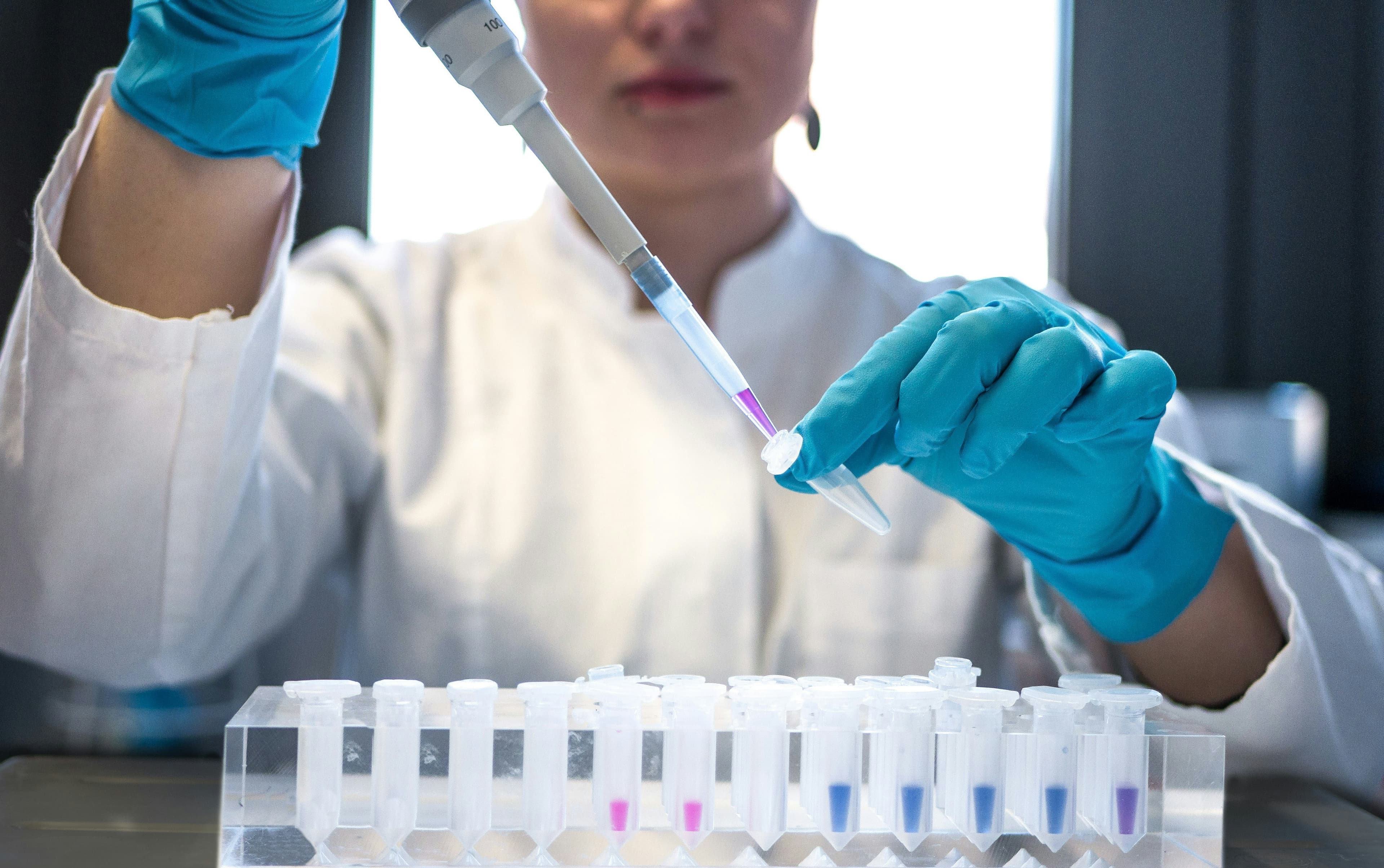
Balances measure grams, but chemical equations count particles. The mole is the bridge between them, and molar mass is the conversion factor that lets you cross it in either direction.
The two conversions
moles = grams ÷ molar mass
grams = moles × molar mass
To find the number of particles, multiply moles by Avogadro's number, 6.022 × 10²³ per mole.
Example 1: grams to moles
How many moles are in 25.0 g of sodium chloride?
- Molar mass of NaCl: 22.99 + 35.45 = 58.44 g/mol
- 25.0 ÷ 58.44 = 0.428 mol
Example 2: moles to grams
What is the mass of 0.150 mol of glucose, C₆H₁₂O₆?
- Molar mass: 180.16 g/mol
- 0.150 × 180.16 = 27.0 g
Example 3: grams to molecules
How many molecules are in 10.0 g of water?
- 10.0 ÷ 18.015 = 0.555 mol
- 0.555 × 6.022 × 10²³ = 3.34 × 10²³ molecules
The molecular weight calculator has grams and moles boxes under the formula, so you can do the first two steps for any compound.
Using the factor-label method
Writing units and cancelling them prevents most mistakes:
25.0 g NaCl × (1 mol NaCl / 58.44 g NaCl) = 0.428 mol NaCl
If the units don't cancel to what you want, the conversion factor is upside down.
A stoichiometry example
How many grams of water form when 4.00 g of hydrogen gas burns completely? The balanced equation is 2H₂ + O₂ → 2H₂O.
- Grams to moles of H₂: 4.00 ÷ 2.016 = 1.984 mol
- Mole ratio: 2 mol H₂ gives 2 mol H₂O, so 1.984 mol H₂O
- Moles to grams of H₂O: 1.984 × 18.015 = 35.7 g
The middle step is a ratio from the balanced equation, which is why chemistry and the ratio calculator overlap more than you might expect.
Significant figures
Report answers to the same number of significant figures as the least precise measurement. Molar masses from the periodic table are usually more precise than your measured mass, so the mass you weighed typically sets the precision.
Common mistakes
- Using the atomic weight of an element instead of the molar mass of the whole compound.
- Forgetting diatomic elements: hydrogen gas is H₂ (2.016 g/mol), not H.
- Dividing when you should multiply; check units.
- Ignoring water of hydration in compounds like CuSO₄·5H₂O; see molar mass of hydrates.
Further reading from official sources
- Atomic Weights and Isotopic Compositions – NIST Physical Measurement Laboratory
- Standard atomic weights – IUPAC Commission on Isotopic Abundances and Atomic Weights