Types of Gravel Explained: Pea Gravel, #57, Crusher Run, River Rock and More
A plain-English guide to the most common gravel and crushed stone types, their sizes, weights and best uses, so you can order the right stone the first time.
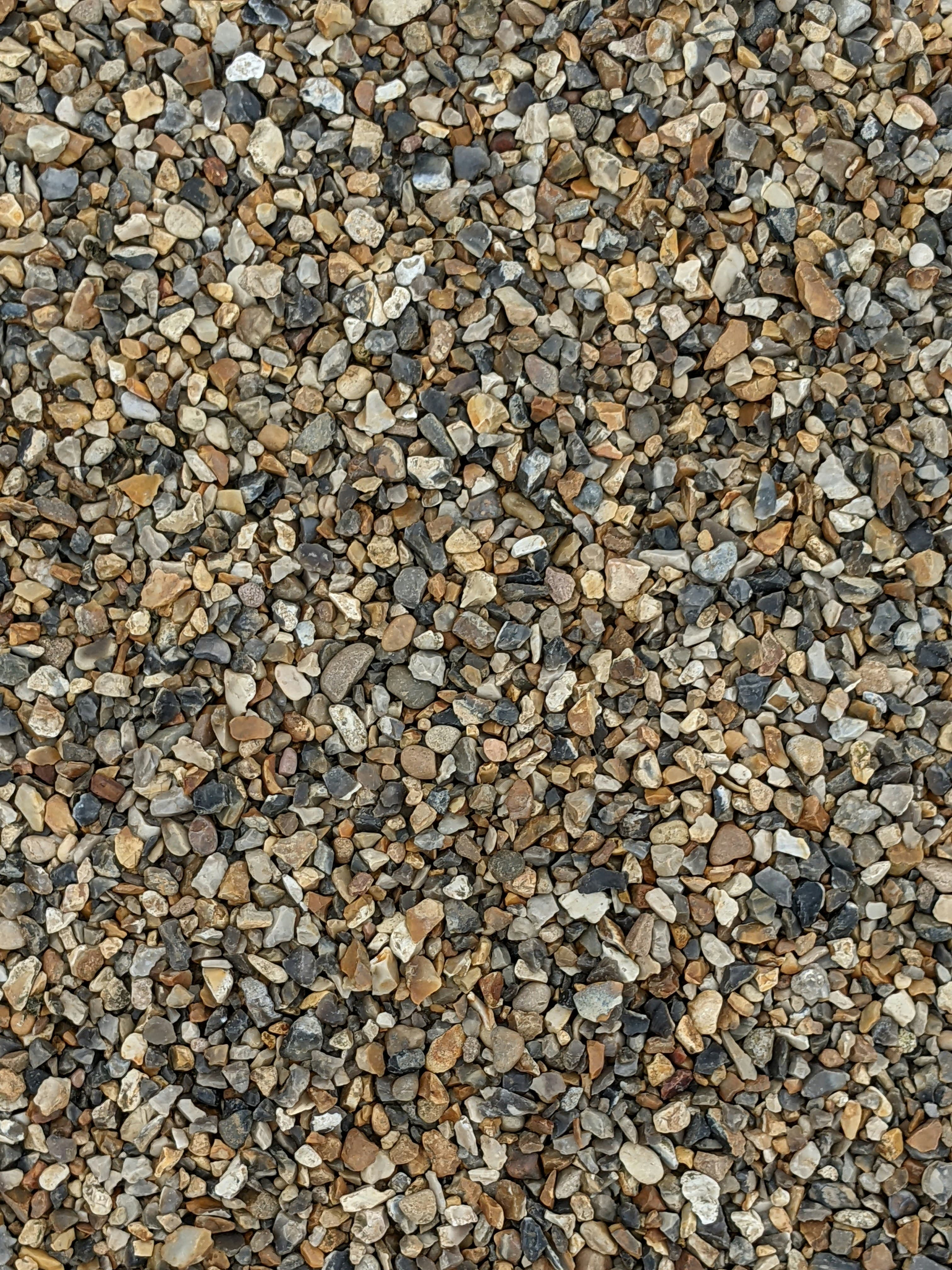
Walk into a stone yard and you'll see bins labelled with numbers, nicknames and regional terms that can be confusing. Most of them fall into a few families. The two questions that matter are: is the stone crushed (angular) or natural (rounded), and does it contain fines (dust and small particles)? Those two properties decide whether it packs into a hard surface or stays loose and drains freely.
Angular vs. rounded stone
Crushed stone has sharp, fractured faces that lock together under pressure, which makes it stable for driveways and bases. Natural gravel such as pea gravel or river rock has been tumbled smooth by water. It feels nice underfoot and looks decorative, but the round pieces roll against each other and never fully stabilize.
Common gravel types
| Type | Size | Shape / fines | Best uses |
|---|---|---|---|
| Pea gravel | ⅛–⅜ in | Rounded, no fines | Patios, paths, play areas, around pavers |
| #8 stone | about ⅜ in | Angular, washed | Paver joints, drainage, concrete mix |
| #57 stone | about ¾–1 in | Angular, washed | Drainage, French drains, driveway middle layer, under slabs |
| #3 stone | about 1½–2½ in | Angular, washed | Driveway base, construction entrances |
| Crusher run (also called road base, dense grade aggregate, #411 in some regions) | up to ¾–1 in plus dust | Angular with fines | Compacted base under pavers and driveways, driveway surface |
| River rock | ¾–3 in and larger | Rounded, smooth | Decorative beds, dry creek beds, around downspouts |
| Decomposed granite | sand-sized to ¼ in | Fine, compacts | Paths, xeriscape patios, around trees |
| Lava rock | ½–2 in | Porous, light | Decorative mulch substitute, fire pits |
| Riprap | 6 in to 2 ft | Large angular | Erosion control on banks and ditches |
The numbered sizes (#3, #57, #8) come from standard aggregate gradations used by many US state transportation departments, but what a quarry calls "#57" can vary slightly. If precise size matters, ask for the product's gradation sheet.
Does stone type change how much you need?
The volume you need depends only on area and depth. The weight depends on the stone's density, which is why the gravel calculator asks for a type. Typical loose densities range from about 1,300 lb per cubic yard for lava rock to around 3,000 lb for crusher run. Ordering 5 yards of lava rock is about 3 tons; 5 yards of crusher run is closer to 7½.
Matching stone to the job
Driveways
Use angular stone in layers: a coarse base, #57 in the middle, and crusher run on top so the surface packs hard. See how much gravel for a driveway.
Walkways and patios
Pea gravel and decomposed granite are comfortable to walk on. Pea gravel needs solid edging and benefits from a stabilizing grid; decomposed granite compacts on its own but can track indoors when wet.
Drainage
Washed stone without fines, such as #57, lets water flow through the gaps. Crusher run would clog. See gravel for drainage and French drains.
Under concrete and pavers
A compacted layer of crusher run or #57 gives a firm, draining base. The concrete calculator helps size the slab itself.
Washed vs. unwashed
Washed stone has had the dust rinsed off. It looks cleaner and drains better, and it costs a little more. Unwashed stone and crusher run contain fines that bind when compacted, which is good for a base and bad for a drain.
Color and appearance
Stone color depends on the local rock: limestone is gray to white, granite can be pink or gray, river rock comes in mixed tans and browns. Wet stone looks darker, so view samples both wet and dry. Imported decorative stone costs much more than local quarry stone, often several times as much per ton.
Quick guide
- Need it to pack hard? Choose angular stone with fines.
- Need water to pass through? Choose washed angular stone.
- Need it to look soft and decorative? Choose rounded stone with edging.
Further reading from official sources
- Construction Sand and Gravel Statistics and Information – U.S. Geological Survey (USGS)
- Mineral Commodity Summaries 2026: Sand and Gravel (Construction) – U.S. Geological Survey (USGS)