How to Measure Curved and Irregular Areas for Soil, Mulch or Gravel
Kidney-shaped beds, winding paths and sloped holes are hard to measure. Four practical methods give a volume estimate you can confidently order from.
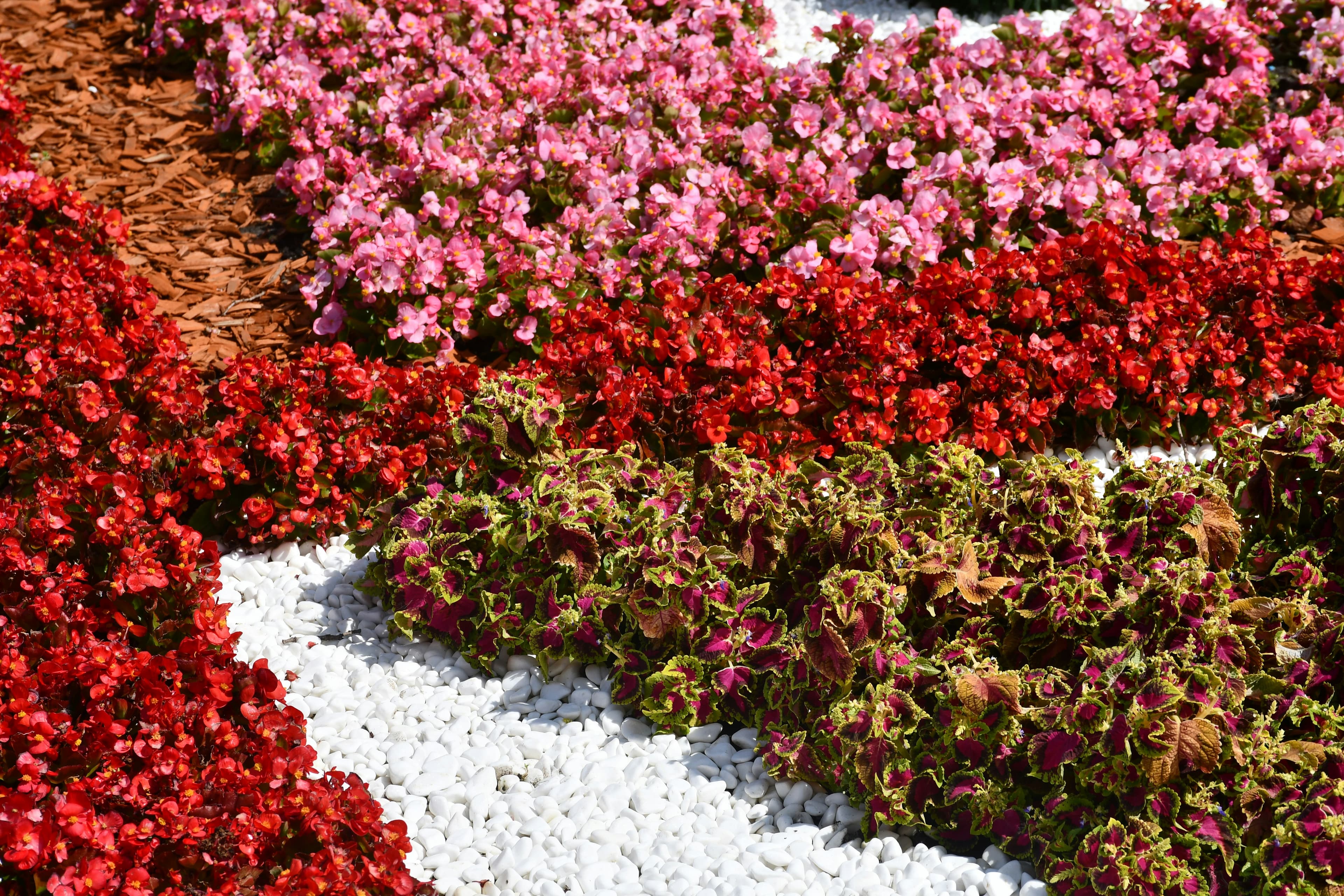
Rectangles are easy. Real gardens rarely are. A sweeping border, an island bed shaped like a bean, or a path that curves around a tree all resist the simple length-times-width formula. The good news is that bulk materials are forgiving: you need an estimate within about 10%, not a survey. These methods get you there.
Method 1: Split the shape into simple pieces
Look at the area from above and divide it into rectangles, triangles and circles or half-circles. Measure each, calculate its area, and add them together.
- Rectangle: length × width
- Triangle: base × height ÷ 2
- Circle: 3.1416 × radius × radius
- Half circle: half of the circle's area
A bed that is a 12 × 5 ft rectangle with a half-circle 5 ft across on each end is 60 + 2 × (3.1416 × 2.5² ÷ 2) = 60 + 19.6 = 79.6 square feet. The square footage calculator lets you list each piece separately and subtract any parts you won't fill.
Method 2: The average-width method
For long, wavy beds and paths, measure the length along the center line. Then measure the width at evenly spaced points, say every 3 or 4 feet, and average those widths. Area is the length times the average width. This is effectively the same idea surveyors use with offsets, and it is accurate enough for any landscape material.
Example: a curving path 40 ft long has widths of 3, 3.5, 4, 3.5 and 3 ft at five points. The average width is 17 ÷ 5 = 3.4 ft, so the area is 40 × 3.4 = 136 square feet.
Method 3: The grid method
For a truly odd shape, lay out a grid of 1 ft or 2 ft squares with string or chalk, or sketch the shape to scale on graph paper. Count the full squares, and count squares that are about half inside as halves. Multiply the count by the area of one square. It is slow but surprisingly accurate, and it works for shapes no formula covers.
Method 4: Use an online map
For large lawns and driveways, many map services let you draw a shape over satellite imagery and read its area. Treat the result as an estimate: trees hide edges, and imagery can be a few years old. Check at least one dimension with a tape.
Measuring depth on uneven ground
Depth is often the larger source of error. If you are filling a low spot or leveling a slope, the depth changes across the area. Drive stakes at several points, stretch a string at the finished height, and measure down to the ground at each stake. Average the readings. For a sloped fill that goes from 0 at one edge to 10 inches at the other, the average is about 5 inches.
From area to volume
Once you have the total area and the average depth, the rest is standard:
cubic yards = area (sq ft) × depth (in) ÷ 324
For the 136 square-foot path above at a 3-inch gravel depth: 136 × 3 ÷ 324 = 1.26 yards. Because gravel is sold by weight, convert with the gravel calculator: about 1.8 tons at typical density.
Holes, trenches and tree pits
For a round hole, use the circle area times depth. For a trench, use length × width × depth. If the sides slope, average the top and bottom widths first. Then use the cubic yard calculator to convert the result.
How much allowance to add
- Simple measured rectangles: 5%.
- Curved beds measured with the average-width method: 10%.
- Grid or map estimates, or very uneven ground: 10–15%.
A little left over can always top up a bed later. Running short means another delivery fee and a patchy finish.
Further reading from official sources
- Unit conversion: SI and U.S. customary units – National Institute of Standards and Technology (NIST)